Quantcelerator
Version 0.1.0 · Windows & Linux · available for acquisition or licence

Backtest. Optimize. Prove it.

A research workstation for systematic crypto strategies. Whole-market backtests in seconds. Exact parameter searches in the tens of millions. Out-of-sample validation on the same engine. One native program, on your own machine.

One real run: a 44,352,000-candidate search, the winner replayed, the report. 2 min 43 s.No mock-ups
10exchanges, spot and USDT-M perpetuals, one local cache
36entry strategies: trend, momentum, volume, market structure
44.35Mexact backtests in 5 min 04 s on one machine
1.37 bnconfigurations scored in 583 benchmark runs, 0 errors
797automated tests; optimizer rows re-checked against backtests
Every strategy looks good in one backtest. Which one survives when you test them all, on data it has never seen?

Fast searches usually approximate. Exact backtests usually take days. Quantcelerator does both at once: every candidate in a search is a complete portfolio backtest, the fast paths are certified against the reference simulation while the run is going, and the winner replays, validates and reports with the same engine and the same numbers.

No accounts, no cloud, no telemetry. Strategies and data stay on the machine.

Capabilities

Five things, one engine

Real exchange data throughout: twelve months of 15-minute candles, every eligible symbol of one USDT-M perpetual-futures market.

Brings its own data

Candles come straight from the exchanges' public endpoints into a local cache. No API key, no data subscription, nothing to import. A run reads the cache first and fetches only what is missing or needs repair.

  • Coverage tables, gap detection and repair, rate-limit retries; only closed candles are stored.
  • Point-in-time universes: delisted symbols stay in, tested only inside the window they traded.
  • Data-quality evidence per symbol on every run. Own candles import as CSV or JSON.
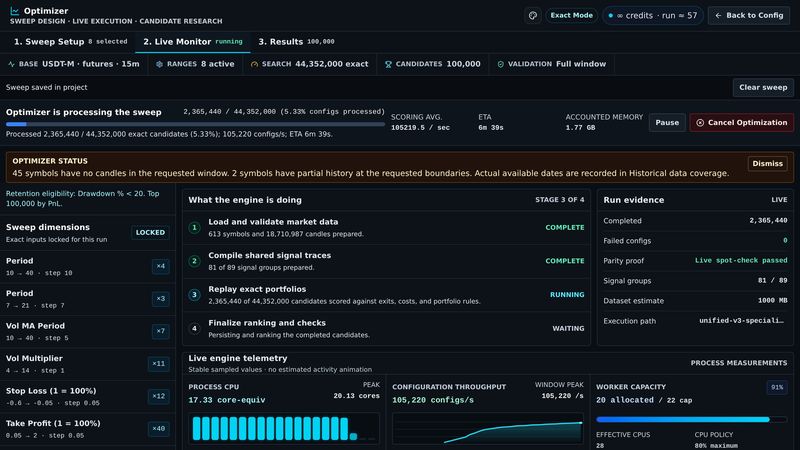
Live monitor: market data loaded and validated
613 symbols, 18,710,987 candles loaded and validated from the cache

Backtests a whole market as one portfolio

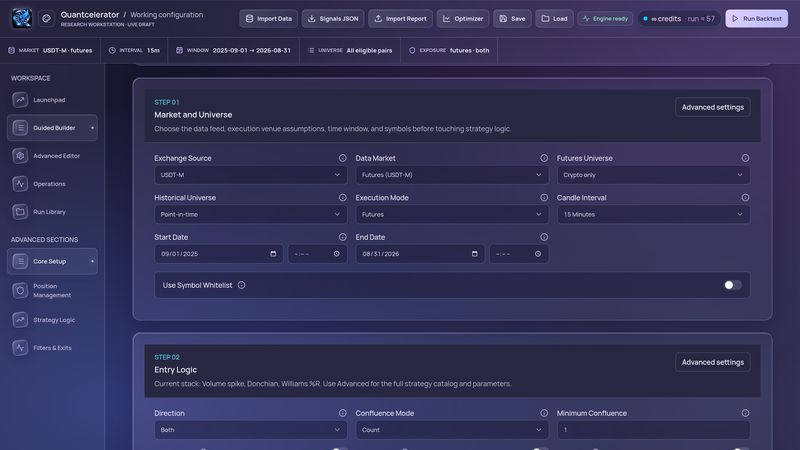
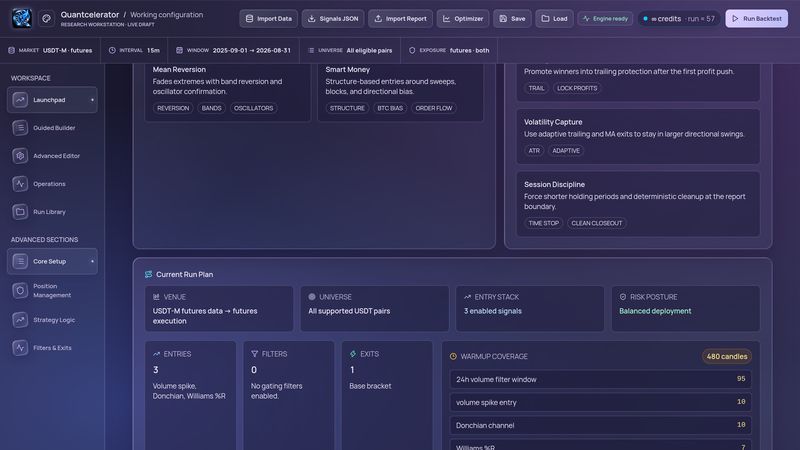
Hundreds of symbols in one account. Fees, spread, slippage, leverage, funding and liquidation modelled. Every signal decided on what was known at the candle's close. Four guided steps to a first run; 323 settings in the advanced editor.

  • 36 entry strategies combined by AND, OR, confluence or weighted ensembles, gated by market, trend, volatility and session filters.
  • Market, limit and stop entries; flat or dynamic costs; five sizing methods; stops, targets, trails and indicator exits.
  • 613 symbols, 18.7 million candles: about 12 seconds from the cache.
Guided Builder: market, interval, window and universe
Guided Builder: market, interval, window, universe

Searches exactly, at scale

Exhaustive grids or seeded random samples over up to 150 parameters. Every leaderboard row is a complete backtest. The fast routes are certified against the full simulation during the run; the live monitor shows the proof. Eligibility bars are enforced during the run.

  • 44,352,000 candidates in 5 min 04 s on 20 threads, 0 failed configurations.
  • Pause and resume. Resume after a restart or crash to the same leaderboard. Reconnect from any tab.
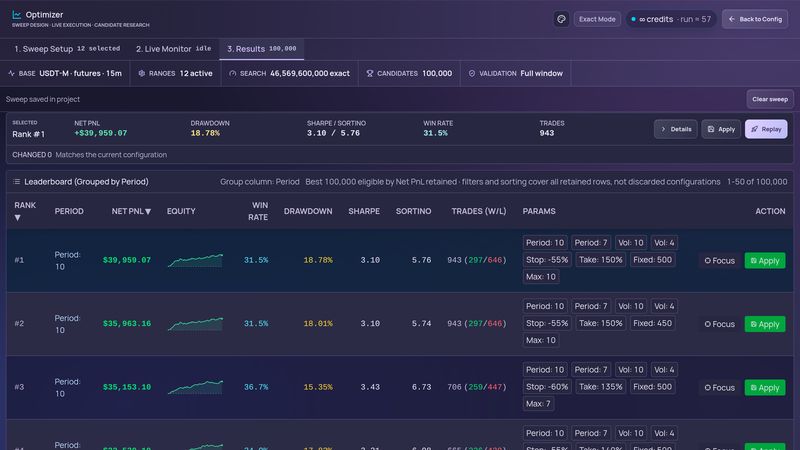
  • Best 100,000 kept. Any candidate applies to the editor, replays as a standalone backtest with identical numbers, or saves as a strategy.
Optimizer leaderboard
Leaderboard and the selected candidate

Validates out of sample

Walk-forward with purge and embargo, probability of backtest overfitting, combinatorial purged cross-validation, a reality check that accounts for the number of configurations searched, significance tests, bootstrap risk and Monte Carlo. All on the same candles and the same engine, so the numbers agree with the leaderboard and the backtest.

  • Walk-forward verdict: the hindsight leader against the choice made without hindsight, fold by fold.
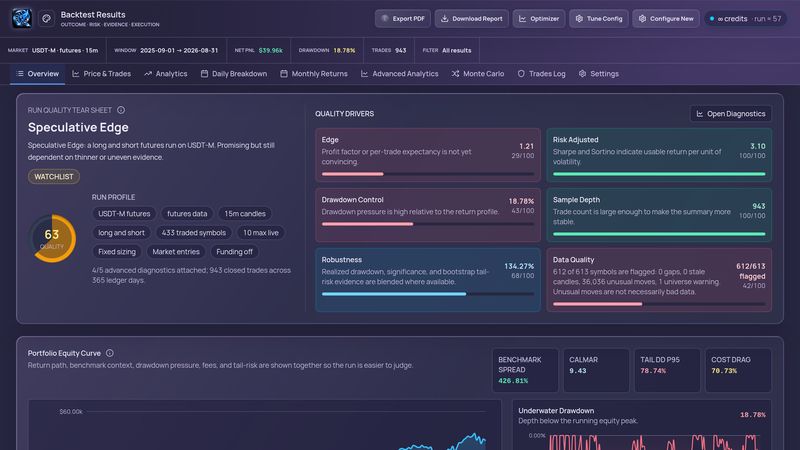
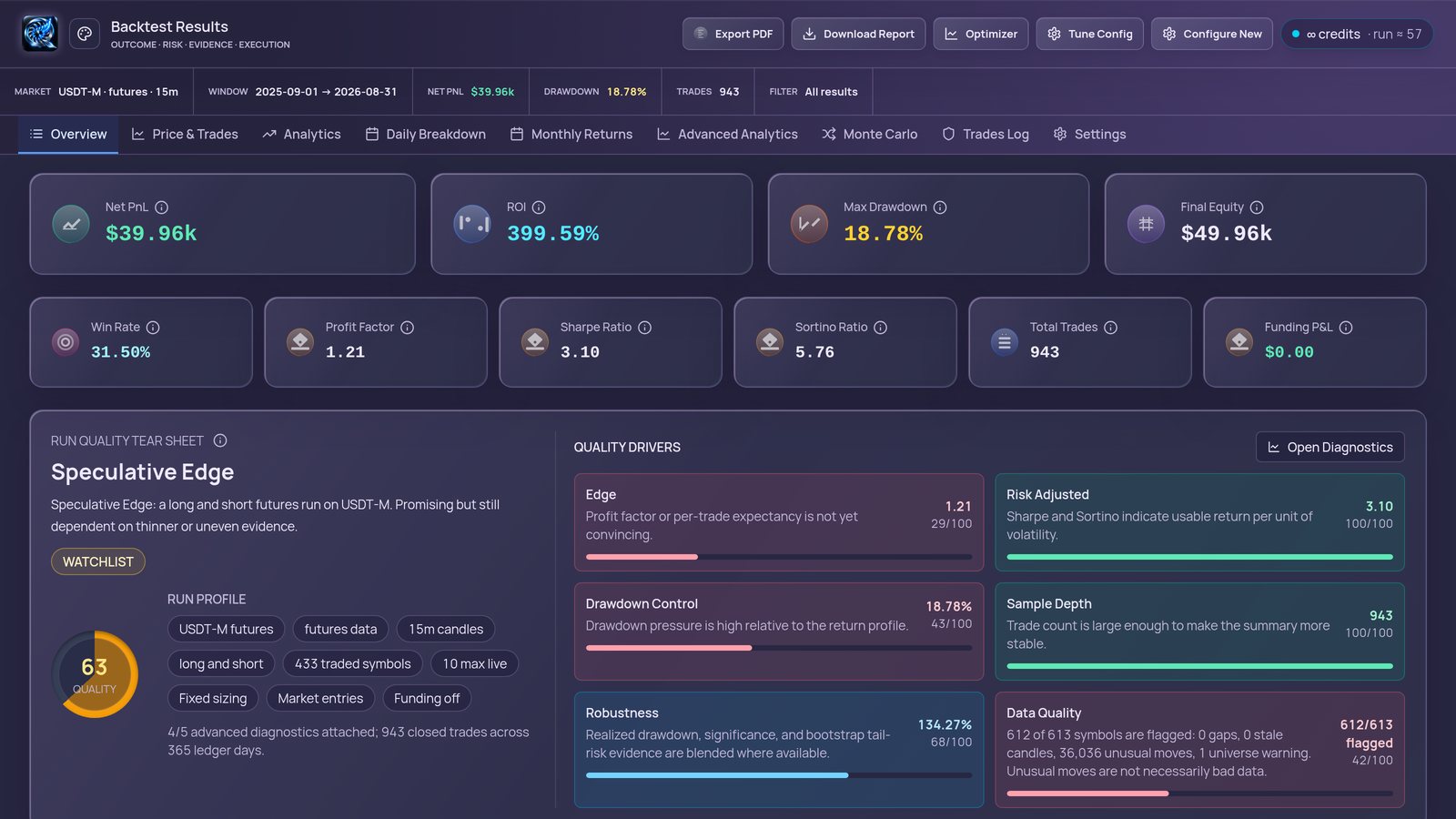
  • Run Quality: a 0–100 grade on six drivers with its evidence. Missing evidence is never a pass.
Run Quality tear sheet

Reports everything

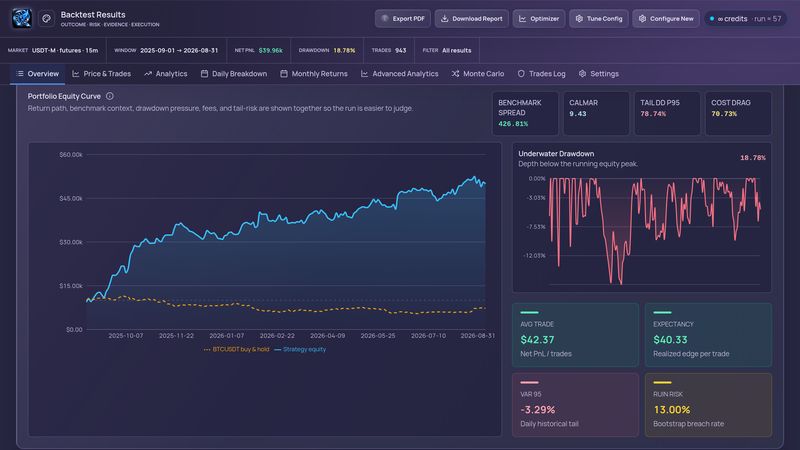
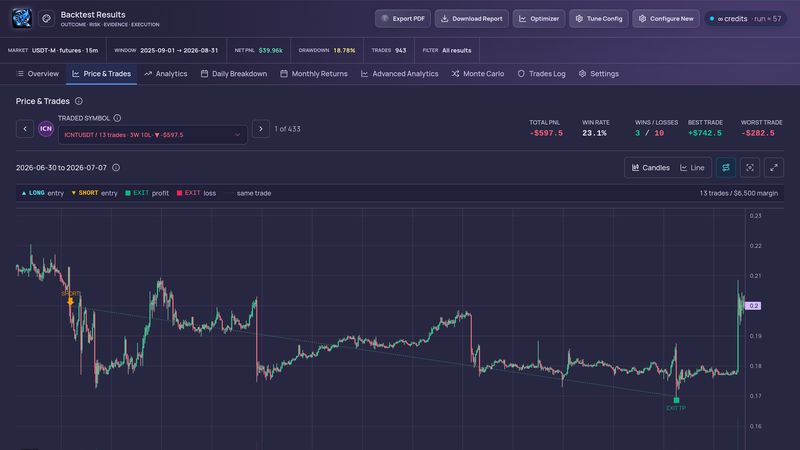
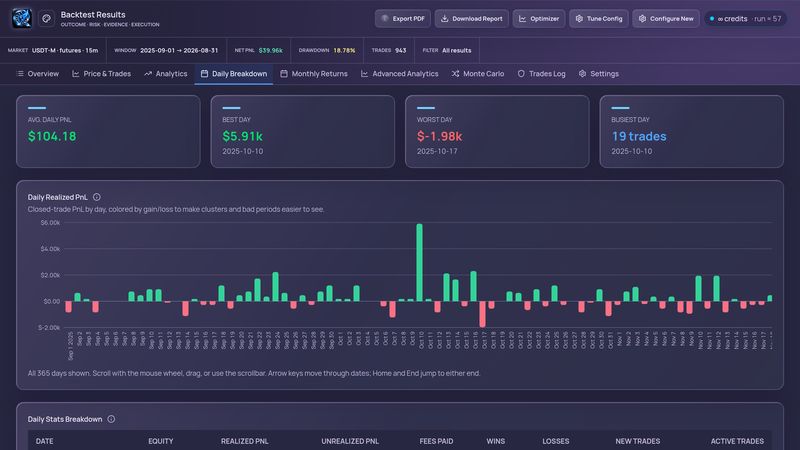
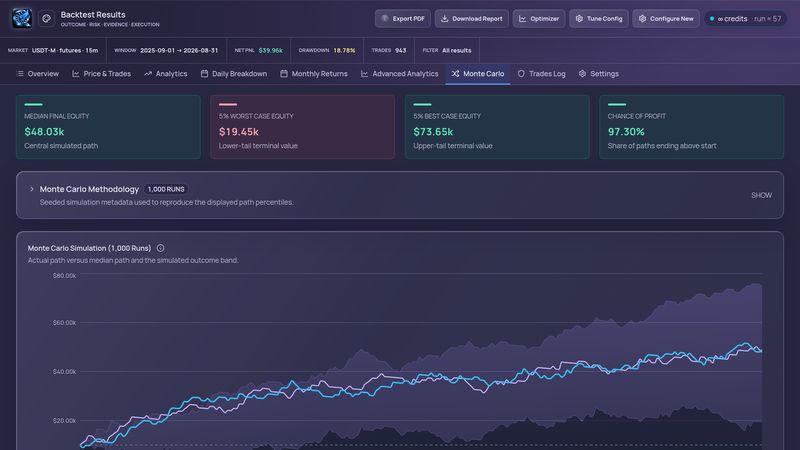
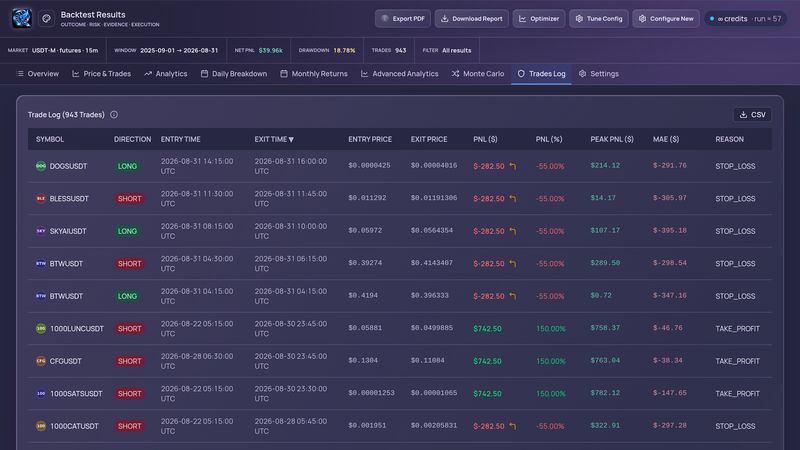
Equity against buy-and-hold with the underwater drawdown. Every trade on the price chart. Performance by symbol, strategy and exit reason. Daily and monthly breakdowns, risk-adjusted and benchmark metrics, Monte Carlo paths, a full trade log with excursions and exit reasons. JSON, CSV and PDF export. Every run archived and comparable.

  • A documented local HTTP API with an OpenAPI contract covers everything the interface does.
  • Eight themes, responsive layout, no brand lock-in.
Equity curve with benchmark and underwater drawdown
Equity, benchmark, underwater drawdown
Inside

Built for serious research

Entries

36 strategies including divergence, candlestick patterns and market-structure entries; invert switch on each.

Signal logic

AND, OR, confluence scoring, weighted ensembles, pairs trading with a cointegration gate.

Filters

Market trend, higher-timeframe trend and signal, ADX, volatility band, session, bias, volume admission, cooldown.

Entry orders

Market, limit and stop entries with offsets and timeouts; fills at the close or the next open.

Costs

Flat fees, spread and slippage, or a dynamic model with market impact and a participation cap.

Sizing

Fixed, percentage of equity, risk per trade, volatility targeting, fractional Kelly.

DCA

Deals with up to ten safety orders, size and step scaling, averaged entry.

Stops and targets

Percentage, ATR multiple, swing level or R-multiple; same-candle priority rule.

Partial take profits

Two partial targets before the final one, optional break-even after the first.

Exit modules

Trailing and ATR trails, dynamic target, profit stop adjustment, time stop, indicator and opposite-signal exits.

Portfolio controls

Open-trade cap, gross, net and cluster exposure limits, global take profit and stop, drawdown halt, daily loss limit.

Futures realism

Leverage, maintenance margin, liquidation with fees, funding at constant, per-symbol or historical rates.

Search control

Exhaustive or random, parameters auto-added, run eligibility, worker count and memory guard per run.

Run lifecycle

Pause with memory held, release and resume later, crash recovery to the same leaderboard.

Validation

Walk-forward with hindsight comparison, PBO, CPCV, Reality Check and SPA, significance, bootstrap, Monte Carlo.

Run Quality

0–100 grade on six drivers with an evidence packet.

Reports

Library and run history, side-by-side comparison with configuration differences, JSON, CSV and PDF export.

Parallel work

Several tabs run separate backtests while a search is in progress; drafts saved per project.

Interface

Launchpad presets, Guided Builder, Advanced Editor, Strategy Garage, Operations, eight themes, mobile layout.

Platform

Windows and Linux builds, offline manual with search, local API with an OpenAPI contract.

Measured

Real exchange data, checked against itself

Through the product's own API on one virtual machine with 28 virtual cores. Speed is configurations fully backtested per second once candles are loaded; every grid re-scores a sample of its rows on the full simulation.

583benchmark runs0 errors, 0 restarts
1.37 bnconfigurations scored, each a complete backtestOctober 12 to 15, 2026
231 / 231optimizer rows re-scored on the full simulation0 differences
434,802 /sfastest grid; group medians 6,000 to 157,000632 pairs · 15m · 20 months

Correctness

  • 224 sweeps, every result row re-run as a separate backtest: 680 rows, 0 differences.
  • 300 random feature combinations swept and backtested: 584 rows, 0 differences.
  • 1,798 backtests with every setting at valid, boundary, out-of-range and wrong-type values: invalid refused by name, accepted consistent.
  • 160 backtests from 16 parallel clients during a running search: identical to the same requests run alone.

Engineering

  • 797 automated tests: simulation, search engine, exchange adapters, storage, API contract. Browser suites against mocked and real backends. Live checks of every exchange adapter.
  • One configuration specification for the API and the interface; invalid settings refused before any data loads.
  • Clean-machine build on a pinned toolchain for Linux and Windows.

Speed depends on the strategies enabled, the parameters swept and their ranges, grid size, symbols, period and hardware. Results are hypothetical backtests on historical data.

Themes

Eight themes, switched live

The report in the selected theme
Prism
Fit

A product, a component, or a brand of your own

Trading firms and desks

Research tooling for a quant team

Exact, exhaustive searches in minutes. Out-of-sample validation built in. Everything on the desk's own hardware. A documented codebase to extend with your own signals, markets and reports.

Platforms, brokers, exchanges

A research product for clients

The engine behind an existing product through its API, or the workstation itself. Ten exchange adapters; a new venue is one adapter in a documented interface. No third-party assets.

Software vendors

Your name on it

Eight themes and no fixed brand. Reproducible builds on Linux and Windows. Original code with permissively licensed dependencies only, each listed with its licence text.

Acquisition of the product and its intellectual propertyExclusive licenceNon-exclusive licence
Built local-first

Made for one machine. Not limited to it.

One native service, bound to the local machine by design. The interface is a client of that service, every function is an HTTP operation, and all state lives on the server side.

Service

Everything is an API call

  • 58 HTTP operations with an embedded OpenAPI contract: market data, configurations, strategies, backtests, optimizer runs, leaderboards, validation, run history, reports.
  • Long-running work streams progress as NDJSON. Optimizer runs carry a token: any client can reconnect, pause, resume or release.
  • Request bodies validated against one specification before work starts.
Operations

Behaves like a server

  • Health, readiness, version and build-identity endpoints; Prometheus metrics.
  • Scheduler admits work by estimated CPU and memory; memory guard stops a job with an explanation instead of swapping; oversized requests get HTTP 429 before parsing.
  • Runs live on the server: reloads reconnect, restarts resume from the last saved batch.
Deployment

Configured, not hard-wired

  • .env file and documented environment variables: port, data paths, memory limits, caches, scheduling, workers.
  • State in documented SQLite and JSON files per data directory; workspaces separate by directory, user or machine.
  • Network exposure, authentication and per-user workspaces are additions in front of the service, not a rewrite.
Package

What comes with it

Included

  • Complete source: Rust backend of about 139,000 lines, TypeScript interface of about 33,000, verification suites, fixtures, build and packaging scripts for Linux and Windows, CI matrix.
  • About 78,000 words of documentation in 21 chapters, every setting, metric formula and API operation, generated into one offline manual. Technical description and benchmark data.
  • 797 automated tests, end-to-end suites, real-engine contracts, live exchange checks, stress harness.
  • Verified source package with a per-file checksum manifest; builds and runs on a clean Linux machine with one script.
  • Original code, permissively licensed dependencies only, no third-party logos or scraped assets, no bundled market data.

Status

  • Version 0.1.0. Research and simulation; no live or paper trading, order routing or exchange accounts.
  • Candle-level simulation on OHLCV data; no tick or order-book replay.
  • Windows 10 and 11 x64, Linux x64. No macOS build, installer, licence enforcement or updater yet; Windows executables unsigned.
  • No users or revenue yet.
  • Known limitations and open issues documented in full.
Contact

Technical description, benchmark data and manual on request.

Source access and a live walkthrough on your own data window under NDA.